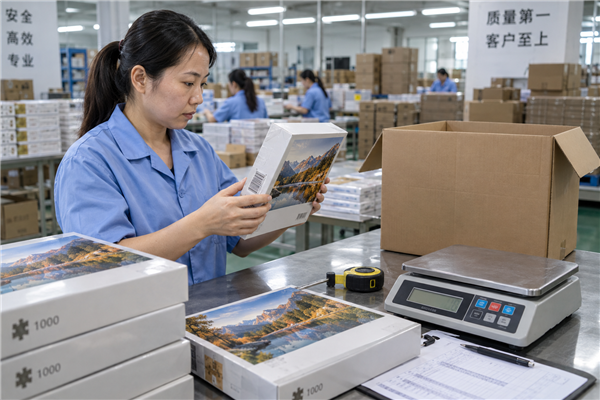
A custom puzzle for Amazon seller needs to work in two environments: it must make sense to a customer on a product page, and it must arrive as correctly identified, protected inventory at the chosen fulfillment route. The factory’s job is to manufacture against an approved specification; the seller’s job is to define the active marketplace, listing, barcode choice, prep route and shipment workflow. Treat those responsibilities as one project brief and the first inbound shipment becomes much easier to control.
Start with a decision-ready project brief
Start with a channel-ready specification. Give a custom puzzle manufacturer for Amazon the current finished size, piece count, board and finish, retail box dimensions, unit weight estimate, SKU, product identifier plan, barcode owner, prep instructions, carton quantity, destination and launch window. Do not assume that an attractive retail box is automatically ready for a fulfillment center. Amazon’s own FBA guidance distinguishes unit identification, packaging and shipment labeling, and its current rules must be checked in the seller account for the relevant marketplace and product. Your factory needs the approved assets and packing instructions; the seller must confirm that they match the active listing and inbound shipment setup.
A practical brief also makes comparisons fair. Give potential suppliers the same core information and ask them to identify assumptions rather than silently filling gaps. This keeps commercial choices visible: which part of the specification creates customer value, which detail is driven by the sales channel, and which item needs a decision from your team. It also gives the factory a usable starting point for installation preparation, prepress review and packing planning.
What a buyer should define before requesting a quote
- Target customer, sales channel, destination market and launch milestone.
- Quantity scenario, finished size, proposed piece count and product application.
- Artwork status, ownership or licensing position, and every planned printed component.
- Packaging direction, inserts, barcode or label needs, and any retailer routing requirements.
- Sample approvers, required factory testing, shipment inspection and freight handover owner.
Buyer checkpoints for this decision
- The selected marketplace, SKU, product identifier and barcode owner are confirmed before box artwork is released.
- The finished unit, retail pack, inserts and any set configuration match the seller’s listing record.
- The seller provides current inbound packing and label instructions before master-carton release.
- Factory checks and shipment inspection compare the selected units and cartons with the approved product and packing records.
A barcode is a controlled product-identification element, not decoration. Keep its approved placement, contrast and version tied to the SKU record, and do not substitute account-generated fulfillment labels for the retail barcode plan without a documented packing instruction.
Choose the product around the customer experience
Choose the product format around a stable inbound process. One puzzle SKU should map to one clearly defined sellable unit: the correct piece count, finished size, puzzle bag, inserts, box and identifier. If several products are packed into a set, define the set as a single sellable unit before artwork and packing begin. Avoid adding an alternate poster, sleeve, bundle or last-minute label without updating the product record. The physical pack, listing details and shipping files should describe the same item. That discipline matters more than creating the greatest possible number of options on a first launch.
When comparing options, ask what changes for the person who receives the product. A specification should have a visible reason: perhaps it protects detailed art, makes an educational activity clearer, supports a gift-worthy unboxing sequence or fits a retailer's shelf. This discipline prevents a common sourcing error in which individual choices look attractive on their own but do not form a coherent customer experience when packed together.
It is also useful to make trade-offs explicit. A more complex format may affect development work, component control or logistics. A simplified pack may improve fulfilment but leave less room for story content. Neither result is inherently right or wrong. The value of a B2B manufacturer conversation is that product, creative and operational implications can be reviewed together while the option is still affordable to change.
Common sourcing risk to avoid
Do not create cartons before the seller has confirmed the active inbound workflow. Carton labels, box contents, marketplace rules and receiving locations can be seller-account-specific and may change after a generic quotation was prepared.
Set up a single source of truth for each sellable puzzle
Before product artwork is finalized, create a SKU sheet that ties together the puzzle format, retail box, component list, listing title, product identifier, barcode version, unit dimensions, shipping weight and carton configuration. The point is not to make the factory manage your Amazon account. It is to ensure that all parties manufacture and pack the same sellable product.
A useful first-launch range is usually controlled rather than broad. If you offer several piece counts or artwork editions, treat each as a separate product record. The GS1 General Specifications describe a GTIN as an identifier for a traded item; your seller team should decide the correct identification approach for its market and channel before asking a printer to place a code on packaging.
Use one approval record for the front, sides and back of the retail pack. This is where the custom puzzle retail packaging becomes connected to the customer-facing listing, not separated from it. It helps avoid errors such as a 500-piece box paired with a 1,000-piece listing or an old code surviving in a revised layout.
- SKU and finished physical format
- Retail barcode and any seller-generated label instructions
- Approved box artwork and component list
- Unit and master-carton measurements
Design the retail pack and master carton as a receiving system
The retail box is the customer unit. The master carton is the unit that factories, freight partners and receiving teams handle. Design both deliberately. A good retail pack presents the artwork, protects pieces and leaves sufficient room for controlled identification. A good carton protects the retail packs, carries the required shipping information and can be counted and measured without guesswork.
Custom puzzle carton packing should be stated in the purchase order and sample record: units per carton, carton dimensions, anticipated gross weight, carton artwork or marks, internal protection and pallet instruction where relevant. A seller should not copy an old carton specification just because it was used for a different puzzle size. Changes to board, box construction or included poster can affect carton fit and shipping data.
Before final release, compare a packed carton with the latest inbound instructions. Amazon’s current guidance says accurate box weight and dimensions are required for shipments and emphasizes the placement and scanability of shipment labels. Treat that as a reason for a final physical check, not a claim that a generic carton has been approved for every future shipment.
Use inspection to protect the handover, not to guess platform rules
A practical inspection plan starts with the approved product reference. For this product, check selected puzzle units for correct artwork, board, piece count, bagging, included components, box version and planned barcode area. Then check selected cartons for count, condition, packing arrangement and the agreed outer marks. Record observations against the actual approval file so a discrepancy can be corrected before the freight handover.
The seller should create or confirm any account-specific fulfillment labels and give clear instructions for who applies them. Do not place labels over seams, edges or an existing scannable code without checking the current platform rule. The factory can follow a documented instruction; it cannot reliably infer which marketplace, shipment plan or labeling owner applies to a seller’s live order.
Keep a release pack with the final specification, sample approval, inspection observations, carton measurements, photos and freight handover details. That record supports a repeat order and helps the seller diagnose an inbound issue without relying on memory or a collection of disconnected messages.

 PuzzleZa
Use the sample as evidence, not as a formality
Use the physical sample to check retail presentation and fulfillment practicality together. Inspect the box dimensions, barcode area, print contrast, bag closure, component list and protection inside the master carton. Custom puzzle barcode printing should be placed in a planned clear zone instead of squeezed into an artwork revision at the end. During factory testing, compare the finished unit with the signed-off artwork, SKU and pack record. A custom puzzle shipment inspection can then verify sampled units, carton count, outer marks and the documented packing configuration before freight handover. It does not replace the seller’s responsibility to follow platform-specific requirements or to verify labels generated in its own account.
Bring the relevant teams into the review in the right order. Creative reviewers can confirm image, copy and visual hierarchy. Product and purchasing teams can check material, components and the commercial specification. Operations teams can review carton information, receiving limits and delivery readiness. Consolidate their feedback into one documented response so the factory receives a clear decision rather than conflicting comments from separate email threads.
The approved sample should answer a practical question for everyone involved: is this the product we are prepared to reproduce, pack, inspect and deliver?
Version control matters at this point. Reference the exact artwork, packaging and component versions in the sample-approval record. If a revision is needed, identify what changed, why it changed and whether another physical sample is necessary. This is not administrative overhead; it is the evidence quality and production teams use later when a project contains several files, SKUs or market versions.
Send Your Requirements
Share the product idea, quantity, artwork status and destination. We will help turn them into a practical custom puzzle brief.
Plan quality control, packing and delivery together
Carton planning is an e-commerce decision, not only a freight calculation. Confirm how many finished units go into each master carton, whether cartons are single-SKU or mixed, the expected gross weight and dimensions, the pallet plan if applicable, and which party applies inbound shipment labels. Amazon’s seller guidance currently emphasizes scannable identification, accurate carton information and labels that are not obscured or placed over edges. Requirements can change and can vary by marketplace, so the seller should provide the live inbound instructions before the final packing release. Keep the approved carton specification and photos with the shipment record for repeat orders.
For the factory, an inspection plan is most useful when it focuses on the details that define your product: correct artwork and pack version, print appearance, die-cut or component checks where relevant, bagging, inserts and carton marks. For the buyer, that same plan makes shipment inspection easier to interpret because the inspector can compare selected finished units with a known approval reference. It also gives freight teams a more reliable handover point.
Keep a final release file with the approved specification, production contact, inspection observations, carton information and agreed shipment documents. This supports a smoother first delivery and becomes valuable information for replenishment. The goal is not to eliminate every uncertainty in a custom product. It is to resolve the important ones at the stage where a correction is still manageable.
Apply the guide to your next puzzle project
This process suits private-label sellers, retail brands, distributors and product teams launching a conventional custom jigsaw through Amazon fulfillment or a comparable e-commerce warehouse. It is designed to create a clear handover between product development, factory packing and inventory receiving.
Use this article as a working conversation tool. Share it with the people who own artwork, purchasing, product compliance and freight, then collect the unanswered questions before a quote is requested. A precise enquiry helps a factory respond with relevant options and helps your internal team distinguish confirmed requirements from preferences that still need a decision.
For material and sourcing context, see Amazon FBA prep, packaging and labeling guidance, Amazon shipping-label requirements, GS1 guidance on trade-item identification. For project-specific manufacturing support, explore our custom puzzle formats, Shenzhen factory capability and production process.
FAQ
What should I send a custom puzzle manufacturer for Amazon?
Send the product specification, SKU list, approved box artwork, barcode plan, current packing requirements, cartons per SKU, destination and launch timeline. Confirm account-specific fulfillment labels through your seller workflow.
Can a factory create Amazon labels for my puzzles?
A factory can apply documented labels when the seller supplies the correct live instructions. The seller should remain responsible for verifying marketplace-specific requirements and labels generated through its own account.
What should a custom puzzle shipment inspection cover?
Compare selected units and cartons with the approved product and pack records: artwork, components, box version, carton counts, protection and required marks. Document exceptions before freight handover.
Why should carton dimensions be approved early?
Carton fit affects protection, freight data, warehouse handling and inbound planning. A change to the retail box or included components can change the carton specification.
Conclusion
A successful amazon-ready custom puzzle program begins with a defined customer outcome and ends with an approved, inspection-ready pack. Align the brief, sample, quality checks and delivery plan early; it gives your team a better basis for an accurate quote and a more dependable first shipment.
Get a Quote