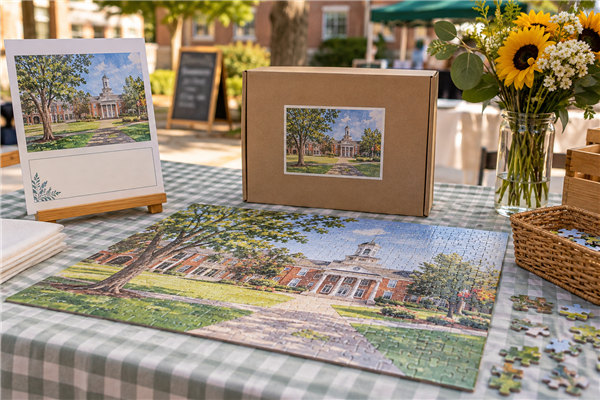
A custom fundraising puzzle works best when it is treated as a real retail product with a clear community story, not simply a logo printed on pieces. Schools, charities and nonprofit teams should define the cause, audience, artwork, sales event, product format and distribution plan before production begins. A physical sample then lets the group assess the customer experience and the practical pack before committing to a larger order.
Start with a decision-ready project brief
State the organization type, campaign purpose, target buyer, anticipated quantity, sales channel, artwork ownership, finished size, piece count, box preference and delivery location. A custom school fundraiser puzzle may feature a campus, local illustration or community project, while a custom charity puzzle may tell a cause-related story through a card or box panel. A custom school logo puzzle can be useful, but important text and marks should be planned on the packaging or insert rather than divided across the assembly surface.
A practical brief also makes comparisons fair. Give potential suppliers the same core information and ask them to identify assumptions rather than silently filling gaps. This keeps commercial choices visible: which part of the specification creates customer value, which detail is driven by the sales channel, and which item needs a decision from your team. It also gives the factory a usable starting point for installation preparation, prepress review and packing planning.
What a buyer should define before requesting a quote
- Target customer, sales channel, destination market and launch milestone.
- Quantity scenario, finished size, proposed piece count and product application.
- Artwork status, ownership or licensing position, and every planned printed component.
- Packaging direction, inserts, barcode or label needs, and any retailer routing requirements.
- Sample approvers, required factory testing, shipment inspection and freight handover owner.
Buyer checkpoints for this decision
- The campaign story, intended buyer and sales channel are clear before format selection.
- Artwork rights, logo use and message content are released in one approval record.
- The physical sample is checked with the full product pack and intended event context in mind.
- Factory testing and shipment inspection use the signed product and packing record as their reference.
A fundraising puzzle should have separate approved files for its puzzle image, box, card or insert and any product identifier. The factory can control those components during production; the buyer owns organization branding, artwork authorization and claims about the campaign or donation.
Choose the product around the customer experience
Choose the format around the way supporters will buy and use the product. A community event might favor a clear, family-friendly image and a compact box; a university alumni program might choose a more detailed campus scene and premium retail presentation. Avoid assuming that more pieces or more copy automatically creates more value. The puzzle should be engaging to complete, easy to understand on a table or shelf, and aligned with the planned sales price and fundraising message without unsupported donation claims.
When comparing options, ask what changes for the person who receives the product. A specification should have a visible reason: perhaps it protects detailed art, makes an educational activity clearer, supports a gift-worthy unboxing sequence or fits a retailer's shelf. This discipline prevents a common sourcing error in which individual choices look attractive on their own but do not form a coherent customer experience when packed together.
It is also useful to make trade-offs explicit. A more complex format may affect development work, component control or logistics. A simplified pack may improve fulfilment but leave less room for story content. Neither result is inherently right or wrong. The value of a B2B manufacturer conversation is that product, creative and operational implications can be reviewed together while the option is still affordable to change.
Common sourcing risk to avoid
Do not present a supplier quotation or early sample as a fundraising revenue guarantee. Quantity, selling price, event attendance, distribution and campaign results remain decisions and risks owned by the organization.
Create a product story supporters can understand
Start with one concise answer to why the puzzle belongs in the campaign. It might celebrate a school, preserve a local view, mark an anniversary or give supporters a useful keepsake. This story should guide the artwork, box and insert instead of being added as a crowded block of text after the product is designed.
Use imagery that is satisfying as a puzzle. Campus buildings, community scenes, local landmarks and original illustration can all work, provided the image retains useful landmarks at the finished size. Keep critical fundraising information, QR codes or event details on the box or a card, where it remains legible and can be updated without redesigning the puzzle surface.
Obtain appropriate approval for logos, photography, illustrations and names before production files are released. A factory can follow the approved creative package, but it should not decide whether an organization has permission to use a contributor's work or a venue image in a retail product.
Sample the supporter experience before producing
A physical sample gives campaign teams a practical product review. Open the pack, assess the image and story card, inspect board and pieces, review box presentation, and return every component to the pack. Include the people responsible for branding, sales and event logistics so the approval reflects the complete product rather than only the artwork.
Record the approved artwork versions, finished dimensions, piece count, board, finish, cut, components and pack layout. During factory testing, selected units can be compared with that reference. This is a more reliable standard than broad instructions such as ‘make it look premium’ or ‘match our old fundraiser.’
Plan the sales presentation from the approved unit. Photograph the real sample, decide how it will sit at an event table or in an online store, and make sure the product description accurately states what supporters receive.
Plan event packing and distribution
Work backwards from the fundraiser date and destination. Confirm the artwork-release date, sample-review window, production release, packing plan, inspection and freight handover. If several schools, alumni groups or retail points receive product, define location counts before cartons are packed.
At shipment inspection, compare selected finished packs and cartons with the approved record for artwork version, components, box, count, visible condition and outer marks. Factory testing and inspection do not determine the campaign's success, but they can reduce preventable product and packing errors before a time-sensitive event.
Keep the final product files, sample approval, carton data and inspection notes with the campaign record. The next annual or regional run can reuse the proven product system while deliberately changing only the approved artwork or message.
 PuzzleZa
Use the sample as evidence, not as a formality
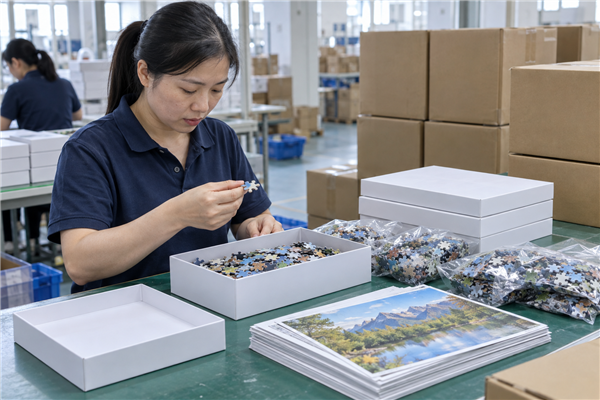
Review a pre-production sample with the actual artwork, board, cut, bag, reference material and box. Open it as a supporter would, check whether the image and campaign story are clear, inspect the piece fit and confirm every component. Factory testing can compare selected production units with the signed sample. Shipment inspection can compare selected retail packs and cartons with the approved product and packing record before freight handover.
Bring the relevant teams into the review in the right order. Creative reviewers can confirm image, copy and visual hierarchy. Product and purchasing teams can check material, components and the commercial specification. Operations teams can review carton information, receiving limits and delivery readiness. Consolidate their feedback into one documented response so the factory receives a clear decision rather than conflicting comments from separate email threads.
The approved sample should answer a practical question for everyone involved: is this the product we are prepared to reproduce, pack, inspect and deliver?
Version control matters at this point. Reference the exact artwork, packaging and component versions in the sample-approval record. If a revision is needed, identify what changed, why it changed and whether another physical sample is necessary. This is not administrative overhead; it is the evidence quality and production teams use later when a project contains several files, SKUs or market versions.
Send Your Requirements
Share the product idea, quantity, artwork status and destination. We will help turn them into a practical custom puzzle brief.
Plan quality control, packing and delivery together
Fundraising events often have a fixed date and several distribution points. Confirm artwork release, sample approval, production, packing, inspection and delivery handover in a documented plan. Record unit pack, carton count, shipping marks and receiving contact for each destination. For repeat annual events, retain the approved sample, product files and inspection notes so the next run begins from a controlled version rather than a collection of old messages.
For the factory, an inspection plan is most useful when it focuses on the details that define your product: correct artwork and pack version, print appearance, die-cut or component checks where relevant, bagging, inserts and carton marks. For the buyer, that same plan makes shipment inspection easier to interpret because the inspector can compare selected finished units with a known approval reference. It also gives freight teams a more reliable handover point.
Keep a final release file with the approved specification, production contact, inspection observations, carton information and agreed shipment documents. This supports a smoother first delivery and becomes valuable information for replenishment. The goal is not to eliminate every uncertainty in a custom product. It is to resolve the important ones at the stage where a correction is still manageable.
Apply the guide to your next puzzle project
This guide is relevant to schools, university programs, foundations, charities, community groups and nonprofit retailers preparing a sellable, story-led puzzle product.
Use this article as a working conversation tool. Share it with the people who own artwork, purchasing, product compliance and freight, then collect the unanswered questions before a quote is requested. A precise enquiry helps a factory respond with relevant options and helps your internal team distinguish confirmed requirements from preferences that still need a decision.
For material and sourcing context, see U.S. Copyright Office: Visual Art & Copyright, Adobe guidance on preparing documents for print, FSC responsible forestry information. For project-specific manufacturing support, explore our custom puzzle formats, Shenzhen factory capability and production process.
FAQ
What should a custom fundraising puzzle include?
Start with the puzzle and a clear retail box. Add a reference or story card when it helps supporters understand the image, community story or campaign context. Review the complete pack physically before release.
Can a school logo be printed on a puzzle?
It can, but important small marks or text are often clearer on the box or an insert. Confirm logo use and artwork approval with the responsible organization before production.
How should a nonprofit plan a puzzle fundraiser delivery?
Work backward from the event or sales date and include artwork approval, sampling, production, packing, inspection and the receiving plan for each destination.
What should be checked before fundraising puzzle shipment?
Compare selected retail packs and cartons with the signed sample and product record for correct artwork, components, board, cut, pack, count and visible carton condition.
Conclusion
A successful fundraising custom puzzle program begins with a defined customer outcome and ends with an approved, inspection-ready pack. Align the brief, sample, quality checks and delivery plan early; it gives your team a better basis for an accurate quote and a more dependable first shipment.
Get a Quote